The year 2025 marked an important intermediate phase for the LIFE LATESTadapt project, focusing on the planning and implementation of nature-based solutions (NbS), the development of demonstration sites, and strong engagement with municipalities, experts, and local communities in Estonia and Latvia. Several partner cities progressed from preparatory work to practical implementation, laying a solid foundation for the following project years.
Planning and Decision Support for Flood-Resilient Nature-Based Solutions
Under the leadership of Tallinn University of Technology, test group meetings were launched to pilot a methodology for assessing risks related to pluvial (stormwater) flooding. In addition to the LATESTadapt partner cities, other interested municipalities and representatives of the Ministry of Climate participated, supporting wider knowledge exchange and cooperation. Project results were also applied in professional training programmes and presented at seminars and workshops, contributing to capacity building in climate adaptation.
High-Potential Plant Communities for Urban Flood Resilience
In 2025, Nordic Botanical tested approximately 62 native plant species under rain-garden conditions. Based on these tests, guidance was provided to municipalities on mapping planting zones and selecting suitable plant communities to enhance urban flood resilience through nature-based solutions.
Demonstration Sites of Nature-Based Solutions
All partner municipalities either carried out preparatory activities for demonstration sites, and several of them constructed demo sites already. More specifically:
Activities in Estonia – Demonstration Sites
In Estonia, activities combined technical planning, construction works, and community engagement to ensure that solutions respond to local needs and spatial contexts.
- Haapsalu
– The design of the pilot site was finalised, and preparations for construction continued. Community involvement played an important role, including a joint engagement event with local residents. The site was also visited by architects and international partners, and a flood preparedness exercise, “November Storm 2025,” was organised to raise awareness among residents. - Viimsi
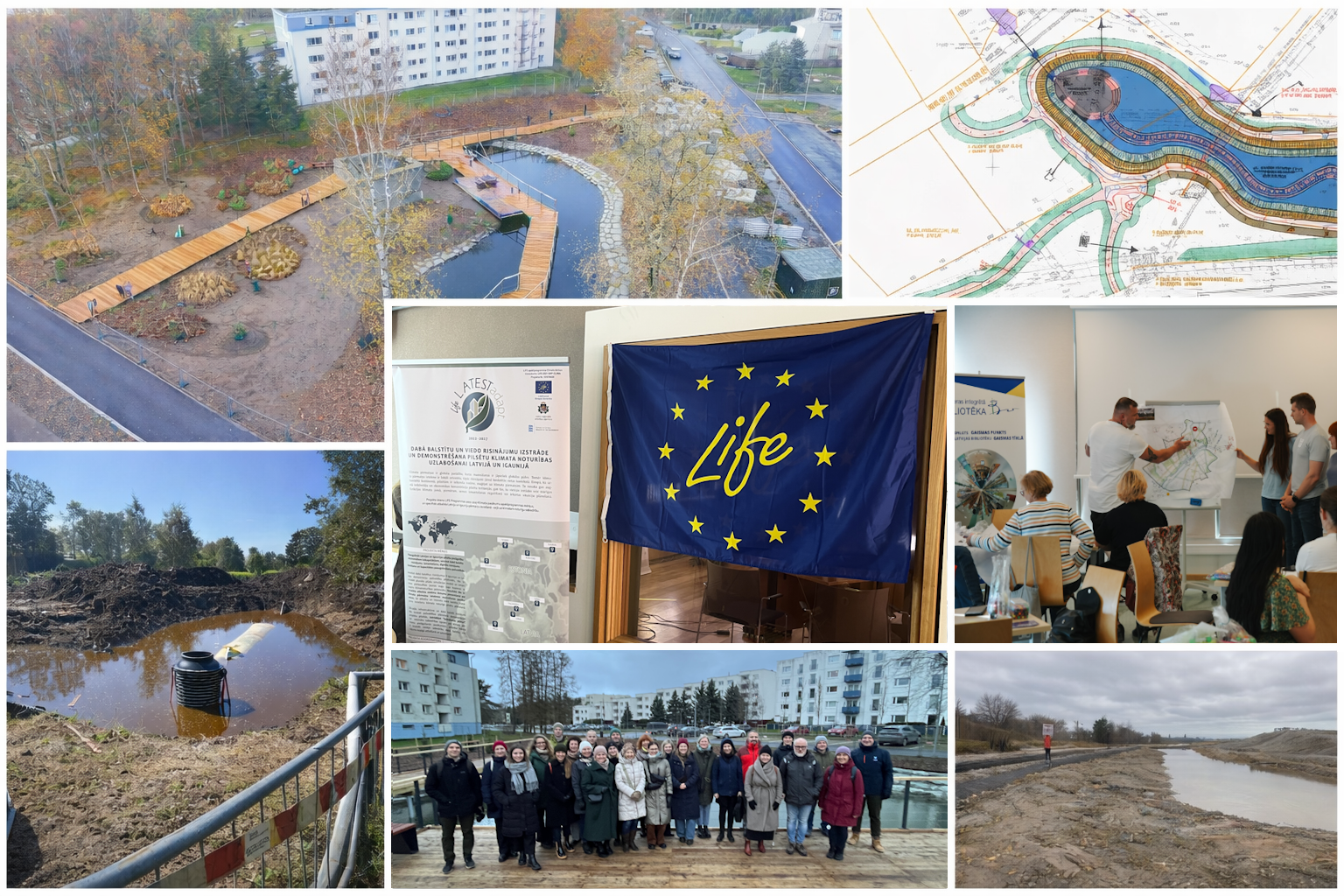
– In the Haabneeme borough, a demonstration site was completed in autumn 2025. A previously underused green area was transformed into a multifunctional public space featuring a nature-based stormwater management system with retention tanks and a pond, used for irrigating greenery and maintenance. The site also includes a boardwalk, urban furniture, and biodiversity-supporting elements, demonstrating how NbS can improve both environmental conditions and the quality of public space. - Narva
– Practical implementation of the pilot site began in 2025 with the construction of a multifunctional drainage system that combines stormwater collection, nature-based purification, and firefighting water storage. Despite an exceptionally rainy summer, most works were completed within budget, with final testing continuing in 2026. - Rakvere
– A detailed design for reconstructing the outflow of the Rahvaaed ponds was completed, aiming to improve water quality, reduce nitrate pollution, and increase flood resilience. A stakeholder meeting was held in autumn, and all necessary approvals and the building permit were obtained by the end of the year. - Võru
-Activities focused on preparatory work. Due to higher-than-expected procurement costs and land ownership issues, the scope of works was revised, and a new procurement is planned for 2026.
Activities in Latvia – Demonstration Sites
In Latvia, Riga, Valmiera, and Cēsis prepared construction design projects and carried out other preparatory work for demonstration sites to be implemented in 2026.
- Valmiera
– Nature-based solutions were integrated into urban development planning through close cooperation with planners, experts, and residents. Implementation scenarios, functional parameters for green infrastructure, and a thematic action plan with budget impact assessment were prepared. Environmental education activities played a key role.
- Riga
– A feasibility study and detailed design documentation were completed for the Tērbatas Street demonstration site, identifying cost-effective green infrastructure solutions such as green walls, rain gardens, parklets, and bio-swales. In parallel, the strategic framework for the Riga Urban Greening Plan 2027–2031 was developed. Extensive stakeholder engagement activities, including seminars and workshops, supported the planning process.
Educational and informational materials for stakeholders
The Baltic Environmental Forum Estonia focused on education, community engagement, and knowledge sharing. Key achievements included the development of practical educational materials for kindergartens and primary schools, support for municipal resident engagement activities, and the preparation of an informational leaflet for private property owners on stormwater-related nature-based solutions. The organisation also participated in study visits and cross-project learning activities.
Co-creation workshops
Baltic Environmental Forum Latvia organised scenario-building workshops involving residents, youth, and experts, helping to identify locally tailored solutions for reducing flood risks and urban heat island effects. in Riga, Cēsis, and Valmiera. Latvian-language catalogue of nature-based solutions was developed, presenting 16 solutions with practical factsheets.
Replication and Knowledge Transfer
Ministry of Smart Administration and Regional Development launched the development of integrated guidelines to support the implementation of nature-based solutions throughout their life cycle. As a key outcome of the LIFE LATESTadapt project,he guidelines will be completed in 2026 and made available in Estonian, Latvian, and English.
In 2025, several international seminars, training events, and participatory workshops were organised, addressing topics such as spatial planning for NbS, urban heat risk mitigation, and climate-resilient stormwater management. Among others Ministry of Smart Administration and Regional Development and Baltic Environmental Forum Latvia organised seminars in cooperation with the IMPETUS project to disseminate project results and practical experience.
Insights from these activities were compiled into a stakeholder engagement report, and a consultation forum was established to support ongoing dialogue between municipalities, experts, and stakeholders.
Conclusion
Overall, the 2025 activities demonstrated the strong value of the LIFE LATESTadapt project in advancing climate-resilient urban development through nature-based solutions. Close cooperation between municipalities, experts, and local communities in Estonia and Latvia created a solid foundation for implementation, monitoring, and the scaling up of solutions in the coming years.