


On 7 August, a discussion titled “Whose Rain, Whose Flood?” took place at the Opinion Festival, focusing on how to cope with increasingly frequent heavy downpours and what roles the state, local governments, water companies, developers and property owners should play in stormwater management. Viimsi Municipality shared its experience and also demonstrated on site how a simple nature-based solution can retain stormwater while making the urban environment more attractive.
The discussion centred on how stormwater management should be organised so that the responsibilities of different parties are clear, costs are distributed fairly and urban areas are better able to cope with large volumes of rainwater. Nature-based stormwater solutions were an important topic, and Viimsi Municipality has gained increasing practical experience in implementing them in recent years.
Deputy Mayor Alar Mik, who presented Viimsi’s experience, emphasised that stormwater should not be seen merely as a problem to be disposed of as quickly as possible, but as a valuable resource that can be retained and used where it falls.
“We see stormwater in Viimsi more as a resource than a problem. With new solutions, the aim is no longer simply to drain water away or slow down its movement, but to find ways to use stormwater locally,” Mik said.
As one example, he highlighted Mereranna Pocket Park in Haabneeme, where stormwater is directed into a pond, buffered and collected in a storage tank. The collected water can later be used, for example, for watering vegetation or cleaning roads.
A pop-up rain garden built in just a few hours
At the Opinion Festival, stormwater solutions were not only discussed in theory. A pop-up rain garden was built on a small green space next to the street, demonstrating how easily an ordinary lawn can be transformed into an area that captures stormwater while also enhancing the urban environment.
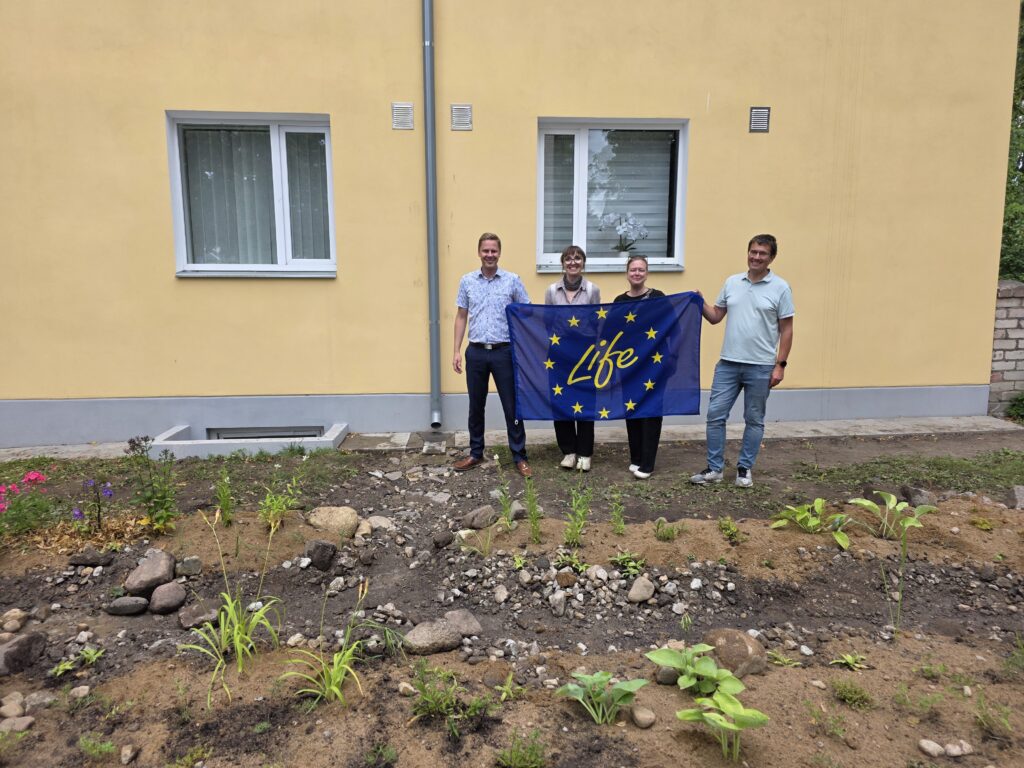
Previously, the green space was covered by an ordinary lawn, and rainwater from the gutter of a neighbouring building flowed onto it. To create the rain garden, a shallow depression was dug between the benches and the existing low area. Different plants were planted there and granite stones were added.
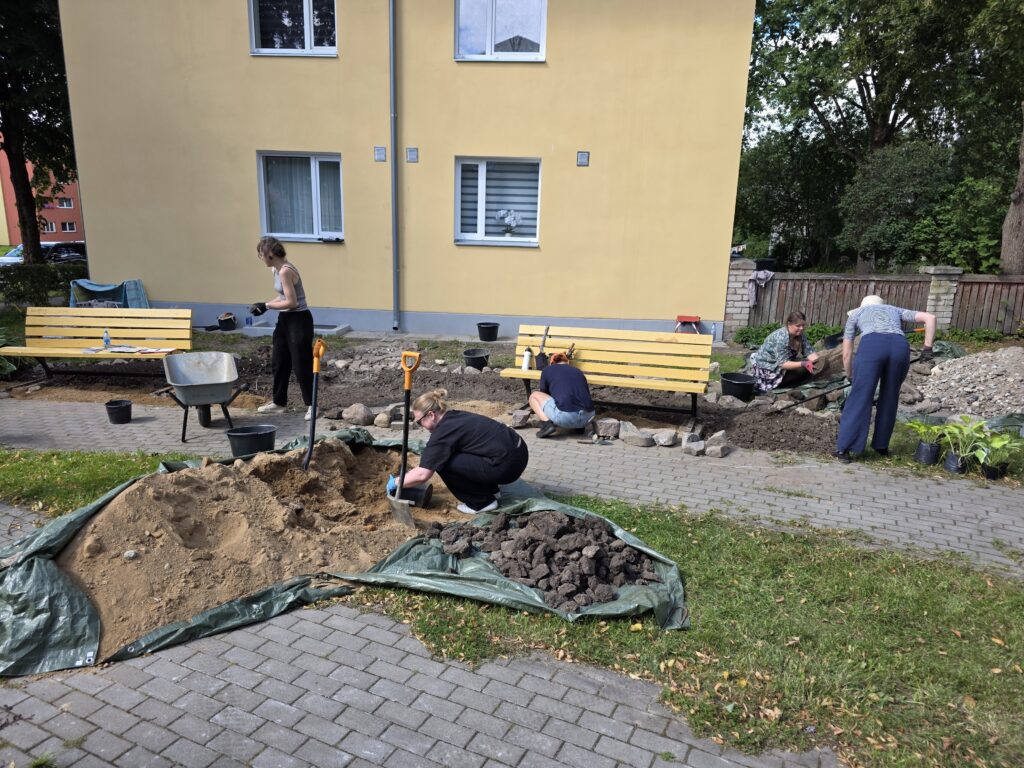
A small stone cascade was created below the downpipe, allowing rainwater from the roof to flow into the lowered planting area. As the water collects at the bottom of the depression, it forms a temporary small pool, from which it can gradually infiltrate into the soil.
Additional low-growing vegetation was planted around the benches, transforming the former lawn into a more complete recreational space. At its centre is a temporary water feature that appears after rainfall, surrounded by flowering plants and providing an attractive sight for passers-by.
As a practical benefit, the rain garden also helps direct roof runoff away from the building’s foundation, while reducing pressure on the conventional stormwater system.
The speed of construction was also significant: the pop-up rain garden was completed in just a few hours. This demonstrates that nature-based stormwater solutions do not always require large-scale or expensive construction works. Relatively simple and affordable measures can be implemented quickly in urban areas to retain stormwater locally, improve growing conditions for vegetation and create more diverse public spaces.
A resilient system is built from many small solutions
According to Mik, however, individual facilities alone are not enough to cope with increasingly intense downpours. A resilient stormwater system is created through many interconnected solutions in both public spaces and on private properties.
“A stormwater system that is resilient to heavy rainfall is made up of many smaller solutions – they are needed both in the street environment and on the properties alongside it. Together, they form an integrated system that collects, delays and uses stormwater as much as possible where it falls. The more water we can retain and use locally, the lower the pressure on the rest of the stormwater system,” Mik explained.
The discussion also addressed how responsibility for stormwater management should be shared between different parties and who should bear the costs of constructing and maintaining the necessary solutions. Clearer roles are becoming increasingly important, as more intense rainfall linked to climate change poses new challenges to existing systems.
According to Mik, local governments need a clear but sufficiently flexible national framework for organising stormwater management.
“It is important that the framework created by the state gives all parties clarity while allowing local governments to organise stormwater management in a way that enables genuinely effective solutions to be implemented. The system must be flexible enough and encourage all parties to contribute towards a common goal,” Mik said.
The discussion “Whose Rain, Whose Flood?” was part of the Opinion Festival’s Water Day programme, which covered topics including climate change adaptation, the condition of water bodies, flood risks, water and food security, and crisis warning systems. The stormwater discussion was moderated by Kristo Elias and organised by Viimsi Municipality and Tallinn University of Technology.