

Where does rainwater go?
Mart Meriste, OÜ Nordic Botanical
In Estonia and Latvia, precipitation is known to be more than evaporation, which means that rainwater must leave the ground in other ways. The most visible natural rainwater solution is streams and rivers, which collect water from the landscape and eventually carry it to the sea. However, this does not happen quickly and all at once, because it takes time for water to accumulate in watercourses. In addition, there are also large water reservoirs in nature that retain water for a long time, such as lakes, swamps and bogs. Sometimes temporary water bodies form in the landscape, such as puddles on roads, fields and forests, as well as floodplains. Some of the water that falls on the ground seeps through the soil and forms groundwater. Thanks to this, rainwater that falls with heavy rains is stored in the landscape for a while and flows away gradually.
One of the biggest problems in densely populated areas is the abundance of surfaces that do not absorb water. Water needs to be drained quickly from roofs, roads and streets, pedestrian paths and parking lots. But where? Usually into the stormwater sewer system and, through it, into a natural body of water. The problem with this solution, however, is that the ability of the pipes to absorb water is limited. It is almost always possible to increase sewer reception capacity, but this tends to be very expensive and complicated, and even in the best case scenario, it can still happen that in the conditions of a changing climate, a few rains will surprise even experienced engineers with their abundance of water. Then cars will drown in the streets again, basements will fill up, water flows will ruin green areas and leaks from flat roofs will cause trouble indoors. However, in countries more mountainous than Estonia or Latvia, it is also possible to see streets that turn into rivers in a short time, and unfortunately, human casualties can also be counted all too often.
This makes us think that perhaps we still have something important to learn from nature.
What is rain garden?
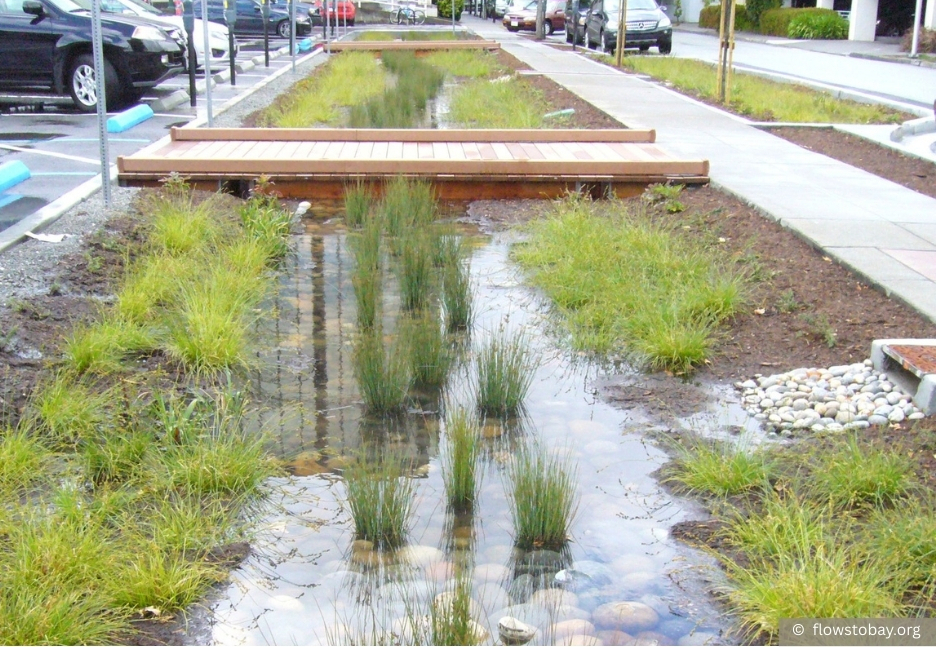
The nature of a rain garden is already indicated by its name. It is usually an artificially created green area, the purpose of which is to temporarily collect rainwater in order to reduce and disperse the load on the rainwater sewer system.
Rain gardens can have very different designs. In most cases, however, they are vegetated depressions on the ground where rainwater is directed. Often, a rain garden also has an outlet and overflow to drain excess water. The surface area of a rain garden consists of soil with good water permeability, under which there is a drainage layer including a drainage pipe. Since the outflow from the rain garden is limited, the water temporarily accumulates in it and later flows into the pipes gradually. In the case of smaller rainfalls, it may happen that all the water seeps into the soil and not a single drop reaches the pipes.
Just like in a proper garden, plants grow also in a rain garden. However, the role of plants in a rain garden is not only to give the technical facility an aesthetic appearance. Plants slow down the flow of water, reduce the amount of runoff, and help purify the water both mechanically, acting as a kind of filter, and chemically, absorbing and storing plant nutrients and other substances contained in rainwater.
Rain garden challenges
Although the area that functions as a rain garden can also be natural, it is usually understood as a man-made structure. To create a rain garden, a large hole must be dug and filled with drainage materials and a substrate that is water-permeable and allows plants to grow. The drainage layer usually consists of crushed stone and perforated drainage pipes inside it that drain the water. A substrate that consists of 50% sand, 25% compost and 25% natural soil can be used as a growing medium. The high sand content allows water to seep in quickly, the compost provides the necessary fertility for plant growth, and the natural soil contains soil biota.
Of course, when building a rain garden, you also need to figure out how the water will get into the garden and from there into the stormwater pipe, ditch, or elsewhere. Once all of that is done, you need to choose the plants. Since this is not an ordinary flower bed, choosing plants requires a little more knowledge. Namely, the conditions in a rain garden are quite challenging for vegetation.
During very rainy periods, the rain garden may be flooded for a long time. If the soil is already saturated with water, the ground will no longer absorb water and it may happen that the winter frosts freeze the entire rain garden and it becomes a small ice rink. Most common bedding flowers cannot tolerate such conditions.
In summer, a heat wave can occur when temperatures rise above 30 degrees and there is no rain for several weeks or even several months. Soil consisting of half sand, with drainage underneath, does not retain water very well and therefore the rain garden is also very drought-sensitive. However, most common bedding flowers cannot tolerate drought.
In addition, some rain gardens receive their water mainly from roads and parking lots, which means that the water is periodically more saline. In the city, in addition to salt, other pollutants from streets and roofs, such as asphalt dust from studded tires, soot from roaring chimneys and exhaust pipes, and accidental leaks from vehicles as well as two- and four-legged city dwellers, reach the rain garden with rain.
So the plant species in the rain garden must be real superheroes.
Native plant species in rain garden
There are about 1,500 native vascular plant species growing naturally in Estonia[MK1] . They are distributed across a wide range of habitats, from limestone crevices in the plateaus to bogs. Different species have different preferences for moisture, light and soil. However, the local weather and climate in general is fairly uniform for all plants, regardless of where they grow. All native plant species can withstand the local climate! Most of them have proven over millennia that they can survive both dry and rainy summers, and both muddy and harsh winters. The species growing here today have so far managed to survive the reduction in habitats, landscape changes, pollution and signs of major climate change that have accompanied the intensification of human activity.
The conditions of the rain garden are somewhat reminiscent of the conditions of several natural communities in Estonia that are flooded from time to time. The best known of these are floodplain and coastal meadows, but also thin-soiled calcareous meadows that become very dry in summer are often under a thin layer of water for a long time in winter. In rainy summers, even normally drier plant communities become waterlogged. Farmers’ crops tend to fail in such years, but natural plant communities are still species-rich and lush under the same conditions. Natural plants have to survive all the vagaries of the Estonian climate without anyone covering them for the winter, spraying them against aphids, or replanting them in case of accidental death. Therefore, the best place to look for plants for challenging conditions has to be the local nature.
In 2023, a test rain garden was established in Tartu County, Estonia as part of the LIFE LATESTadapt project (lifelatestadapt.viimsivald.ee/et) to test the resilience of native plants. A total of 62 species of native plants were planted in the garden: Dianthus arenarius, Dianthus deltoides, Lychnis viscaria, Silene dioica, Aquilegia vulgaris, Ranunculus acris, Ranunculus auricomus, Ranunculus polyanthemos, Trollius europaeus, Alchemilla sp., Filipendula ulmaria, Geum rivale, Potentilla argentea, Potentilla erecta, Anthyllis vulneraria, Lotus corniculatus, Ononis arvensis, Trifolium fragiferum, Trifolium montanum, Hypericum perforatum, Lythrum salicaria, Angelica sylvestris, Pimpinella saxifraga, Primula farinosa, Asperula tinctoria, Galium album, Galium boreale, Galium verum, Polemonium caeruleum, Myosotis sylvatica, Clinopodium vulgare, Origanum vulgare, Prunella vulgaris, Stachys officinalis, Thymus pulegioides, Thymus serpyllum, Linaria vulgaris, Plantago lanceolata, Plantago media, Veronica chamaedrys, Veronica longifolia, Veronica spicata, Veronica teucrium, Succisa pratensis, Campanula rapunculoides, Campanula rotundifolia, Centaurea jacea, Centaurea scabiosa, Eupatorium cannabinum, Knautia arvensis, Leontodon autumnalis, Pilosella officinarum, Senecio jacobaea, Serratula tinctoria, Solidago virgaurea, Tanacetum vulgare, Agrostis capillaris, Anthoxanthum odoratum, Cynosurus cristatus, Deschampsia cespitosa, Molinia caerulea, Sesleria caerulea.
In addition to these species that grow in similar conditions in nature, plants that were assumed not to be able to survive there in the long term were also planted in the test bed for control purposes. The results so far after two very different summers and winters are somewhat surprising. Namely – all the planted plant species are alive! It is not very strange to see Polemonium caeruleum, Filipendula ulmaria, Lythrum salicaria or Eupatorium cannabinum in flooded areas. However, it is a little surprising to see violet flowers of Dianthus deltoides, colorful Anthyllis vulneraria or a carpet of Thymus serpyllum growing under a 15 cm layer of water.
How can this be? Let’s try to answer this question. First, the plants in the test garden are planted there, not spread and grown from seed. However, spreading and growing from seed to large plant is the most difficult stage in the life of a plant. Second, good gardeners keep the test plants away from each other and do not let them compete with each other. Third, we do not let plant species that we have not planted – so-called weeds, which could eventually crowd out the planted plants – grow in the test garden.
From the experiment, we can conclude that if we want to create a truly durable landscaping solution, there is nothing better than native plant species! And also that we have different choices, depending on what we want to do and how much we can invest in maintenance. If we can weed and plant additions, it is possible to grow a wide variety of native plant species in a rain garden. If we cannot afford so much maintenance, the choice of species will probably be smaller and it is possible that natural selection will cull some plants and add species that were not originally planted there. If the goal is to plant a rain bed and ensure its durability and functionality, both options are good.
Contribution of a rain garden to biodiversity
In an era of rapid biodiversity loss, it is important to protect and promote it wherever possible. Cultivated plants are undoubtedly beautiful and a bee can eat a mouthful of them, but our domestic biodiversity is actually based on domestic plant species. Each domestic plant species is associated with dozens or even hundreds of other species. The biota of our soils – fungi, roundworms, potworms, soil mites, springtails and thousands of others – mainly use the surface layer of the soil as their habitat, where their habitat is formed by the roots of plants and the decay that occurs when the above-ground parts die. The majority of our beautiful domestic butterfly species spend their caterpillar stage eating the leaves of our domestic plants, and in addition to the domesticated honeybee, we have over 200 species of wild bees, dozens of species of bumblebees and countless other insects that feed on flower nectar and pollinate plants. Plants are also eaten by a large number of our wild mammals and birds. These and the insects that feed on plants, in turn, become food for our predatory animals. This is how natural ecosystems work.
Any landscaping solution should consider its impact on biodiversity. However, if it can be combined with an environmentally friendly rainwater solution, an exceptionally durable landscaping solution, and the modest beauty of Nordic flowers, then there are no losers.